Wednesday, December 4, 2013

Crank by Ellen Hopkins

Crank by Ellen Hopkins

Prompt: Who has “power” in your text? How does that power get shown?
Crank is a story about a teenage girl Kristina who sometimes goes under the alias Bree.  As Kristina she’s a straight A student, perfect daughter.  When Bree takes over, she becomes a smooth talking girl out for meth.  One summer she goes to visit her dad, and ends up trying meth for the first time, and soon she’s hooked.  Once home she does many things all ending up in bad situations to get crank.  The end of the book has gone through many things, such as dealing to other addicts in her town, raping her, discovering she’s pregnant, relapses, jail time, and meeting Chase, who is mostly a good and helpful guy. 
            Technically the “who” is crank in this situation.  The drug has complete control over Kristina, her actions, her behavior and her happiness.  Most of the time all Kristina thinks about is meth.  Where and who she can get it from, how she can take it, how long her stash will last.  The only real reason she was dealing meth was so she could have more of it for herself.  It had become an addiction and a lifestyle.   All the really thought about was her drugs, many times over family and friends.  Even though she was pregnant she couldn’t always stop her pull to crank.  It is shown throughout the whole book, but near the end when she’s going through withdrawal that’s when you see just how much power it had over her.  Fighting it seemed so hard for her.  The crashes were really bad too.  In those moments it shows just how much control meth had over her, because you could see how she somehow depended on it.

            I choose this question because it seemed fitting and a good way to show the affect crank had on her.  Although it dealt with several hard issues, Crank was a very well writing book, which invoked good points about the life of an addiction (through their point of view).  Because the author has experience, her daughter being a meth addict, it seemed very heartfelt and raw.   All in all, I really liked this book.

Wednesday, November 20, 2013

Advertisement

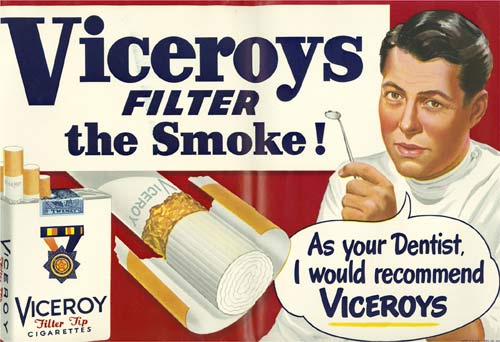
Cut and paste advertisements: What do you believe the advertisers are trying to get you to think about?

In the cigarette ads from the 1950’s, most said things that were later proved to be completely untrue.  Presently, these advertisements would be categorized as “politically incorrect”.  The ads said things such as, “Chesterfield is best for you” and “more doctors smoke camels than any other cigarette.”   Both implying that they are good for you, or that doctors promote smoking- which they always tell people not to do.  By saying this, the advertisers wanted consumers and other people seeing these, to think they wouldn’t harm your health.  Given that these ads were a little older then when people started going into detail about what smoking could cause, it still was a lie most advertisers new the truth about.  Then there were other advertisements that would say “blow in her face and she’ll follow you anywhere.”   For this, the advertisers were trying to say that by smoking (around girls), it would make girls more into them.  All in all, to sell their cigarettes, advertisers lied and tried to please different groups.

Saturday, November 9, 2013

Banned Books Letter

Dear Ms.Berner,

As many parents have been asking you to remove books, you seem to be considering the banning of certain books in the 6th grade libraries.  Although they may seem to be younger, these books are an important part of their education. By reading YA books, 6th graders start to be aware of tragic issues that they need to know about.  Also, you never know what’s happening in someone’s life, a YA book could really help him or her through something.  “Censorship is the enemy of truth.  Even more then a lie.  A lie can be exposed, censorship can prevent us from knowing the difference.” (Bill Moyers)For all of these reasons, no books should be banned from the 6th grade classrooms, because these books could be helping some students and in actuality you can’t protect them.
             Many children start dealing with heavy subject in their lives at young ages.  So by the time they’re in middle school, they turn to YA books and reading the endings gives them hope.  “There are millions of teens who read because they are sad and lonely and enraged.  They read because they live in often-terrible worlds.  They read because they believe… that books- especially the dark and dangerous ones- will save them.” (Why The Best Kids Books Are Written In Blood).   Reading young adult books can shelter kids in vulnerable positions.  You never know what’s happening in someone’s life, including the 6th graders in MS51.   If you can’t believe me when I say young adult fiction can help these students, Ellen Hopkins, among many other young adult authors, says that she has met thousands of fans saying how her books saved her.  “She [a girl Hopkins met] started getting high in middle school, mostly as a way to deal with her alcoholic mothers absence… But one day, she found my book.  She saw herself in those pages, and suddenly knew she didn’t want to be there… Today she’s been sober two years, is graduation high school… this wasn’t a rare encounter.”  (Banned Books Week 2010: Anti Censorship Manifesto).  Without these YA books in her class libraries, who knows where she and so many others would be.  In young adult fiction, yes-dark subjects are brought up, but at the end there is always a happy ending where the person struggling survives.  So when the students are reading about someone in the same situation as them who ends up all right, they are filled with the thought that there will be a brighter time.
The parents who are demanding books to be banned think they’re doing it to protect the young middle school students.  But really, there’s nothing to protect them of.  As stated in, ‘Sick-Lit’? Evidently Young Adult Fiction is too complex For the Daily Mail, “Illness, depression, sexuality- these are all issues that teens are going to bump up against in their lives, whether directly or at one remove, through family members, friends or representations in other media such as TV, films, and the internet.”  I think that perfectly describes how in practice, taking away these helpful books really won’t protect anyone.  In most cases, the children in 51 (and most middle schools) either already know about these issues through media, or have experienced them first hand.  Once again there are many people who say how silly it is, from things that have happened to them.  “They wanted to protect me from sex when I had already been raped.  They wanted to protect me from evil though a future serial killer had already abused me… they aren’t trying to protect the poor from poverty.  Or victims from rapists.  No, they are simply to protect their privileged notions, of what literature is and should be.  They are trying to protect privileged children.  Or the seemingly privileged.” (Why The Best Kids Books Are Written In Blood).  Kids everywhere (including this school) are abused.  Whether it be physically, sexually, verbally, it all hurts.  Now when these children say that YA books help them, and for someone to want to take that away isn’t right.  In the United States alone, everyday around 4 to 7 children die from child abuse.  Many terrible things happen all the time and these issues are taught in YA books.  So by “protecting” them (which isn’t really helpful in the first place) you are also creating ignorance on important subjects-which is the opposite of education.
Meghan Cox Gurdon makes a lot of claims against young adult fiction in her article Darkness Too Visible.  One being that everything in YA section was incredibly dark.  To this I agree with Maureen Johnson who said, “the idea that ‘darkness’ doesn’t belong in stories makes me wonder if the author of this article [Gurdon] has ever read any Poe, Dickens, Shakespeare, Hemingway, Tolstoy… or even the bible.” (Yes, Teen Fiction Can Be Dark- But it Shows Teenagers They Aren’t Alone).  The authors here are some of the most famous, that have written the most beautiful pieces of literature ever made.  And all of those books are full of rape, murder and some of the darkest and chilling moments written.  Saying young adult books should be disregarded because they are dark, is an ignorant point.  Another thing that Gurdon said is that these young adult books should be banned in big measures, not just for a couple students, but also in entire states.  That is a ridiculous way to think.  For a parent not to want their child to read a book, is completely fine; they are entitled to choose what they think is best for their own children.  But they have no right to decide what is good or bad for other people.  It’s selfish and unethical.  Why would it be up to one or two people to tell others exactly what they aren’t able to do?  If people let others control their books, a smaller issue like this one could turn into bigger issues.  Then we would all be under a type of dictatorship.  It may seem far-fetched and exaggerated, but so are Meghan Cox Gurdon’s accusations.
To sum up, I feel that there are many valid points as to why you shouldn’t consider banning books.  If a parent is uncomfortable with a book then all they have to do should be not to allow their son or daughter to read it.  Out of the 1,000 plus students in 51, a handful of parents shouldn’t have the power to restrict powerful books.  The fact that the books they want to ban are the same that have literally saved lives should be enough.  Not only that, but young adult books are educational and addresses important life topics.  Everyone should have the option to read what they want; even the 6th graders for project R.E.A.L.  “Believe nothing no matter where you read it, or who said it, no matter if I have said it, unless it agrees with your own reason and common sense.” (Buddha).  


Saturday, October 19, 2013

"Where Your Cellphone Goes to Die" by Leyla Acaroglu

“Where Your Cellphone Goes to Die”
By Leyla Acaroglu


            “Where Your Cellphone Goes to Die” is about e-waste, how it affects people, and what can be done to have it be reduced.  In the article, Acaroglu reminds us that the United States is sending enormous amounts of electronic waste to places such as China, Ghana, and India.  There you can find young children and pregnant women, working in dangerous conditions.  What these men, women and children do, is try to extract copper, wires, gold and silver threads by smashing batteries with mallets, burning huge mountains of electronics and "cooking" circuit boards.  This can leave toxic pieces lying on their hands, and has them inhaling the smoke of the burned items.  Side effects of these things are neurological damage (brain damage) and challenge child development.  I think that if the United STates tried, it wouldn't be hard to change the e-trash disposal practices.
            With a minimum effort from the government, manufacturers and consumers, e-trash disposal would be much safer for others and would reduce the trash itself.  The government could simply just sign a treaty, and put an act to vote.  "The united states... could ratify the Basel Convention, an international treaty that makes it illegal to export or traffic in toxic e-waste... The Responsible Electronics Recycling Act... would make it illegal to export toxic wast from the U.S to developing countries that have limited or no safeguards... despite support from both Democrats and Republicans it was never put to vote." These act and conventions could decrease the danger people in Ghana, India and China are working in.  For the manufacturers, they could find better alternatives to the waste.  For example, the E.U (European Union) requires that all who sell the electronics need to accept all items of theirs for recycling.  "The goal is to properly recycle 85 percent of the E.U's e-waste by 2019."  In Japan all who manufacture electronic have to have their own recycling facilities.  Finally, the consumer.  To help, the consumer can pressure the government and manufacturers by demanding better solution for the trash, and they can take it upon them to recycle their electronic devices.  "Consumer pressure on manufacturers to design electronics that can be more easily recycled could be enormously helpful... we [consumers] could recycle the ones we no longer use through certified recycling services."  That can help be recycling properly, and having better devices to begin with.
            As you can see, there needs to be change in the way we handle electronic waste.  The fact that people can suffer, just because consumers are throwing an old phone away, is not something that can be ignored.  With a little effort from everyday consumers, the ones in charge of manufacturing these devices, and the United States government, change could come progressively.

Wednesday, October 2, 2013

Smack by Melvin Burgess

SMACK
By Melvin Burgess

            “Smack” is a story with many real world issues.  Gemma a 14-year-old girl runs away with her boyfriend Tar.  Soon they meet 16-year-old couple Rob and Lily and move into a squat with them.  Starting off with small drugs such as marijuana, Gemma and Tar soon escalate to class A drugs; heroin.  To afford their “hobby” Lily and Gemma become prostitutes, and Rob and Tar deal a little on the side.  The story goes through all their challenges, until Gemma is pregnant and her and Tar go home at 18 to raise their kid.  In this book Gemma, Tar, Rob, and Lily all have several ways of coping with big and small situations, some good and some bad.

            The obvious way all of these characters cope in common is running away.  They all ran away from home at very young ages (Lily 12, the rest 14) for their own reasons.  But that’s not the only time they ran away from problems in their life.  When Tar and Gemma are in their first squat with Richard, Vonny and Jerry, as soon as they don’t like it anymore they meet new people and leave in the middle of the night, no explanations.  “’ I ought to go away… and leave him because maybe he’d stand a better change without me.’” (Page 256) This was when Gemma wanted to run away from Tar so he could get clean.  Another way the characters deal with conflict, is when Tar is upset, he goes and paints.  “I went back to my room and I got out the pastels… and had a go at the dandelion.” (Page 143) Tar dealt with his emotions by pouring them out into his drawing.  He didn’t stop for hours.  A less positive way to deal with issues is when they were tight on money.  “There was a big handful of tenners [money] coming down from the ceiling… Rob grabbed the notes and went bombing off to get some [drugs]… We said, ‘we’ve been little prossies [prostitutes] for half an hour.’” (Page 184).  This was in the beginning when it was only an occasional thing, but they quickly found a gig daily.  There are other ways characters deal with issues, such as Rob’s skills in stealing, the drugs, drug dealing and the occasional phone call home.


            Those are some of the examples of how characters in the book dealt with issues in their lives.  Some of those were harmful to them, or dangerous, but others were simple ways that many people can relate to.  All in all, "Smack" was a very good book, with an interesting plot and issues, and characters you could feel sympathy towards.